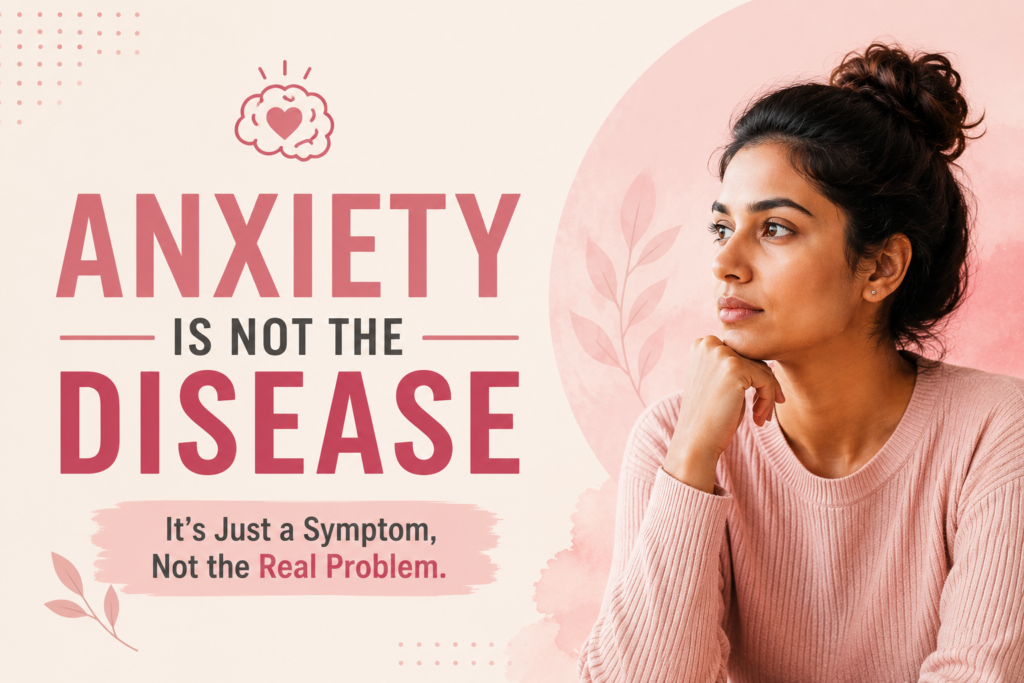
Anxiety Is Not the Disease: It’s the Alarm System

“I Just Want My Anxiety to Go Away”

This is one of the most common statements I hear in therapy.

People come looking for ways to stop overthinking, calm panic attacks, reduce nervousness, and feel less anxious.

While these goals are important, there is something many people misunderstand:

Anxiety is often not the actual problem. Anxiety is a symptom.

Just like a fever is not the disease but a sign that something is happening inside the body, anxiety is your mind and nervous system’s way of signaling that something deeper needs attention.

Unfortunately, many people spend years fighting the symptom without understanding the source.

Why Anxiety Shows Up

Anxiety is the body’s survival mechanism.

Your brain is constantly scanning for danger. When it perceives a threat, it activates the fight, flight, freeze, or fawn response.

The challenge is that the “danger” is not always present in the current moment.

Sometimes the threat is:

  • Childhood emotional wounds
  • Unresolved trauma
  • Fear of rejection
  • Fear of failure
  • Perfectionism
  • Abandonment wounds
  • Chronic stress
  • Suppressed emotions
  • Low self-worth
  • Relationship conflicts
  • Unprocessed grief

In these situations, anxiety becomes the messenger.

The real issue lies beneath the surface.

The Mistake Most People Make

Most anxiety treatments focus solely on symptom management:

  • Deep breathing
  • Positive thinking
  • Distraction techniques
  • Relaxation exercises
  • Temporary coping strategies

These tools can provide relief and are valuable.

However, if the root cause remains untouched, anxiety often returns.

It’s similar to turning off a fire alarm while the fire continues burning in another room.

The noise stops.

The danger remains.

What Anxiety Might Be Trying to Tell You

Anxiety often carries a hidden message.

It may be saying:

“I don’t feel safe.”

“I am afraid of being judged.”

“I learned that making mistakes is dangerous.”

“I am carrying emotions I never processed.”

“I don’t trust myself.”

“I am living according to other people’s expectations.”

Until these underlying beliefs and emotional experiences are explored, anxiety can continue appearing in different forms.

Looking Beneath the Surface

In my work as a psychologist and hypnotherapist, I rarely see anxiety as the final diagnosis.

Instead, I become curious about:

  • What happened before the anxiety started?
  • What emotional experiences shaped this pattern?
  • What beliefs are driving the fear?
  • What unmet needs are still seeking attention?
  • What part of the person is trying to stay protected?

When we begin asking these questions, the healing process changes.

Instead of fighting anxiety, we start understanding it.

Real Healing Happens at the Root

When the root cause is identified and addressed, many people notice:

  • Reduced anxiety naturally
  • Increased emotional resilience
  • Better relationships
  • Improved self-confidence
  • Greater inner peace
  • Less overthinking
  • Better decision-making

This happens because the nervous system no longer needs to stay on constant alert.

Anxiety Is Not Your Enemy

Anxiety is not trying to ruin your life.

It is trying to protect you.

The problem is that it may be protecting you from dangers that no longer exist.

The goal is not to silence anxiety.

The goal is to understand what anxiety is trying to communicate and heal the deeper wounds creating the signal.

Ready to Discover the Real Cause Behind Your Anxiety?

If you have tried managing anxiety but still find yourself stuck in the same cycle, it may be time to look deeper.

Through counselling, subconscious exploration, hypnotherapy, and evidence-based psychological approaches, we work together to uncover the root patterns beneath anxiety and create lasting transformation—not just temporary relief.

Because true healing begins when we stop asking:

“How do I get rid of anxiety?”

And start asking:

“What is my anxiety trying to tell me?”
Subscribe
Join our community of 3 million people and get updated every week We have a lot more just for you! Lets join us now
Related Post
Depression: The Messenger You Keep Trying to Silence

Depression: The Messenger You…

What If Depression Isn’t Trying to Hurt You? Most people see depression as…
Stop Fighting Depression. Start Understanding It.

Stop Fighting Depression. Start…

What If Depression Is Not Your Enemy? Most people spend years fighting depression.…
The Real Reason You Feel Depressed (And It’s Not What You Think)

The Real Reason You…

Most People Are Looking in the Wrong Direction When people experience depression, they…

Free Trauma Impact Assessment

Discover your emotional baseline. Where should we send your personalized results?

100% Secure & Confidential

Question 1 of 35

1. Unwanted memories from painful experiences suddenly enter my mind.

Question 2 of 35

2. I replay past events repeatedly, even when I don't want to.

Question 3 of 35

3. Certain situations trigger intense emotional reactions connected to my past.

Question 4 of 35

4. I have disturbing dreams or nightmares related to painful experiences.

Question 5 of 35

5. At times, it feels like I am reliving a painful event.

Question 6 of 35

6. Small reminders can bring back strong emotional distress.

Question 7 of 35

7. I struggle to let go of memories from the past.

Question 8 of 35

8. I feel emotionally overwhelmed more easily than others.

Question 9 of 35

9. I experience sudden sadness without fully understanding why.

Question 10 of 35

10. I frequently feel fear, anxiety, or panic.

Question 11 of 35

11. I experience intense anger that feels difficult to control.

Question 12 of 35

12. I often feel emotionally numb or disconnected.

Question 13 of 35

13. I feel guilty about things that happened in my past.

Question 14 of 35

14. I carry shame about myself because of past experiences.

Question 15 of 35

15. I constantly scan my environment for potential danger.

Question 16 of 35

16. I find it difficult to fully relax.

Question 17 of 35

17. I become easily startled by unexpected sounds or events.

Question 18 of 35

18. I often expect something bad to happen.

Question 19 of 35

19. I struggle to feel safe, even in secure situations.

Question 20 of 35

20. I have difficulty trusting people.

Question 21 of 35

21. I feel emotionally guarded around others.

Question 22 of 35

22. I avoid situations that remind me of painful experiences.

Question 23 of 35

23. I avoid talking about certain parts of my life.

Question 24 of 35

24. I distract myself to avoid difficult emotions.

Question 25 of 35

25. I withdraw from people when I feel emotionally triggered.

Question 26 of 35

26. I suppress my feelings rather than express them.

Question 27 of 35

27. I avoid places, people, or activities associated with painful memories.

Question 28 of 35

28. I feel disconnected from activities I once enjoyed.

Question 29 of 35

29. I often feel broken or damaged because of what happened to me.

Question 30 of 35

30. I struggle to see myself as worthy of love and respect.

Question 31 of 35

31. Past experiences have negatively affected my confidence.

Question 32 of 35

32. I frequently criticize or blame myself.

Question 33 of 35

33. I feel stuck in survival mode rather than truly living.

Question 34 of 35

34. I sometimes question my value as a person.

Question 35 of 35

35. My past continues to influence important decisions in my life.

0 Your Score
"This assessment is based on standardized psychological frameworks and is intended for self-awareness, not clinical diagnosis."

Free Relationship Attachment Style Assessment

Discover your emotional baseline. Where should we send your personalized results?

100% Secure & Confidential

Question 1 of 28

1. I feel comfortable depending on people I trust.

Question 2 of 28

2. I can express my emotional needs without fear.

Question 3 of 28

3. I generally believe people who care about me will remain supportive.

Question 4 of 28

4. I am comfortable with both intimacy and independence.

Question 5 of 28

5. Conflicts in relationships do not make me question the entire relationship.

Question 6 of 28

6. I can communicate my feelings openly and respectfully.

Question 7 of 28

7. I trust that healthy relationships can withstand challenges.

Question 8 of 28

8. I often worry that people I love will leave me.

Question 9 of 28

9. I need frequent reassurance that I am valued.

Question 10 of 28

10. When someone becomes distant, I immediately fear rejection.

Question 11 of 28

11. I often overthink texts, calls, or small changes in behavior.

Question 12 of 28

12. I feel anxious when I do not hear from someone important to me.

Question 13 of 28

13. I fear being abandoned more than most people.

Question 14 of 28

14. My self-worth is strongly influenced by how others treat me.

Question 15 of 28

15. I prefer handling emotional problems alone.

Question 16 of 28

16. I become uncomfortable when people get too emotionally close.

Question 17 of 28

17. I struggle to ask for help even when I need it.

Question 18 of 28

18. I value independence more than emotional connection.

Question 19 of 28

19. When relationships become intense, I tend to pull away.

Question 20 of 28

20. I find it difficult to fully trust others.

Question 21 of 28

21. I often feel trapped when someone depends heavily on me.

Question 22 of 28

22. I want close relationships but often fear being hurt.

Question 23 of 28

23. I find myself pushing people away even when I care deeply about them.

Question 24 of 28

24. I often feel confused about what I want from relationships.

Question 25 of 28

25. I fear both abandonment and intimacy.

Question 26 of 28

26. I expect relationships to eventually become painful or disappointing.

Question 27 of 28

27. I experience strong emotional ups and downs in close relationships.

Question 28 of 28

28. Part of me wants connection while another part wants to run away.

0 Your Score
"This assessment is based on standardized psychological frameworks and is intended for self-awareness, not clinical diagnosis."

Free Invisible Burden Assessment

Discover your emotional baseline. Where should we send your personalized results?

100% Secure & Confidential

Question 1 of 35

1. I feel emotionally drained even after resting.

Question 2 of 35

2. I often carry worries that I rarely share with others.

Question 3 of 35

3. I feel like I am dealing with more than people realize.

Question 4 of 35

4. I find it difficult to switch off my thoughts.

Question 5 of 35

5. I feel emotionally exhausted from constantly managing life's demands.

Question 6 of 35

6. I often suppress my emotions to keep functioning.

Question 7 of 35

7. I feel mentally overwhelmed by responsibilities.

Question 8 of 35

8. I constantly think about problems that need solving.

Question 9 of 35

9. Even during calm moments, I struggle to relax.

Question 10 of 35

10. I feel responsible for keeping everything together.

Question 11 of 35

11. I worry about the future more than I would like.

Question 12 of 35

12. I often feel pressure to appear strong.

Question 13 of 35

13. I rarely allow myself to fully rest without guilt.

Question 14 of 35

14. I carry stress that others may not notice.

Question 15 of 35

15. I keep difficult emotions to myself.

Question 16 of 35

16. I avoid burdening others with my struggles.

Question 17 of 35

17. I often tell myself to "just deal with it."

Question 18 of 35

18. I minimize my own pain because others have problems too.

Question 19 of 35

19. I struggle to ask for support when I need it.

Question 20 of 35

20. I continue functioning even when I am emotionally depleted.

Question 21 of 35

21. People often assume I am doing better than I actually am.

Question 22 of 35

22. I prioritize other people's needs over my own.

Question 23 of 35

23. I ignore signs that I need rest.

Question 24 of 35

24. I feel guilty when I focus on myself.

Question 25 of 35

25. I often push through exhaustion instead of slowing down.

Question 26 of 35

26. I struggle to maintain healthy boundaries.

Question 27 of 35

27. I put pressure on myself to meet unrealistic expectations.

Question 28 of 35

28. I feel responsible for other people's emotions.

Question 29 of 35

29. I often feel alone in what I am carrying.

Question 30 of 35

30. I sometimes wonder how much longer I can keep going like this.

Question 31 of 35

31. I feel disconnected from joy or excitement.

Question 32 of 35

32. I miss feeling like myself.

Question 33 of 35

33. I feel stuck in survival mode.

Question 34 of 35

34. I wish someone truly understood what I am carrying.

Question 35 of 35

35. I feel weighed down by emotions I have not fully processed.

0 Your Score
"This assessment is based on standardized psychological frameworks and is intended for self-awareness, not clinical diagnosis."

Free Anxiety Assessment

Discover your emotional baseline. Where should we send your personalized results?

100% Secure & Confidential

Question 1 of 21

1. How often have you been bothered by the following problems?

Question 2 of 21

2. How often have you been bothered by the following problems?

Question 3 of 21

3. How often have you been bothered by the following problems?

Question 4 of 21

4. How often have you been bothered by the following problems?

Question 5 of 21

5. How often have you been bothered by the following problems?

Question 6 of 21

6. How often have you been bothered by the following problems?

Question 7 of 21

7. How often have you been bothered by the following problems?

Question 8 of 21

8. How often have you been bothered by the following problems?

Question 9 of 21

9. How often have you been bothered by the following problems?

Question 10 of 21

10. How often have you been bothered by the following problems?

Question 11 of 21

11. How often have you been bothered by the following problems?

Question 12 of 21

12. How often have you been bothered by the following problems?

Question 13 of 21

13. How often have you been bothered by the following problems?

Question 14 of 21

14. How often have you been bothered by the following problems?

Question 15 of 21

15. How often have you been bothered by the following problems?

Question 16 of 21

16. How often have you been bothered by the following problems?

Question 17 of 21

17. How often have you been bothered by the following problems?

Question 18 of 21

18. How often have you been bothered by the following problems?

Question 19 of 21

19. How often have you been bothered by the following problems?

Question 20 of 21

20. How often have you been bothered by the following problems?

Question 21 of 21

21. How often have you been bothered by the following problems?

0 Your Score
"This assessment is based on standardized psychological frameworks and is intended for self-awareness, not clinical diagnosis."

Free Depression Assessment

Discover your emotional baseline. Where should we send your personalized results?

100% Secure & Confidential

Question 1 of 21

1. Sadness

Question 2 of 21

2. Pessimism

Question 3 of 21

3. Past Failures

Question 4 of 21

4. Loss of Pleasure

Question 5 of 21

5. Guilty Feeling

Question 6 of 21

6. Punishment Feeling

Question 7 of 21

7. Self Dislike

Question 8 of 21

8. Self Criticalness

Question 9 of 21

9. Suicidal thoughts and wishes

Question 10 of 21

10. Crying

Question 11 of 21

11. Agitation

Question 12 of 21

12. Loss of Interest

Question 13 of 21

13. Indecisiveness

Question 14 of 21

14. Worthlessness

Question 15 of 21

15. Loss of Energy

Question 16 of 21

16. Change in sleeping pattern

Question 17 of 21

17. Irritability

Question 18 of 21

18. Changes in Appetite

Question 19 of 21

19. Concentration Difficulty

Question 20 of 21

20. Tiredness or Fatigued

Question 21 of 21

21. Loss of Interest in Sex

0 Your Score
"This assessment is based on standardized psychological frameworks and is intended for self-awareness, not clinical diagnosis."