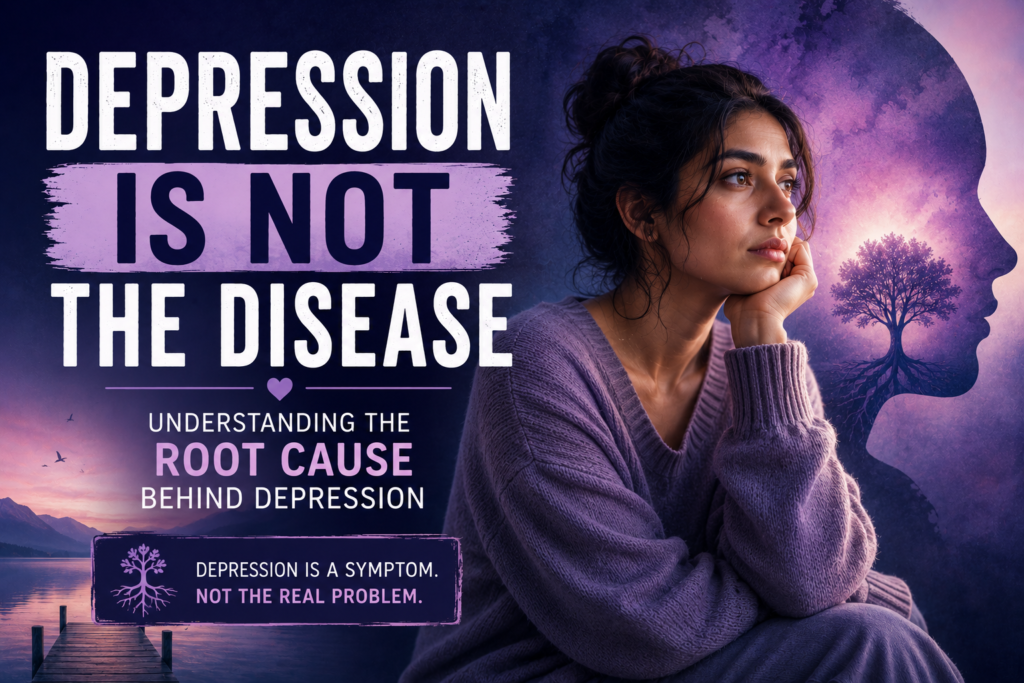
“Why Am I Feeling This Way?”
Many people living with depression ask themselves the same question.
“I have a good job. Why am I depressed?”
“I have a family who loves me. Why do I still feel empty?”
“Nothing terrible is happening in my life. Why do I feel so disconnected?”
These questions often create confusion, guilt, and self-judgment.
People begin believing something is wrong with them.
That they are weak.
Broken.
Unmotivated.
Or incapable of happiness.
But what if depression is not the actual problem?
What if depression is the symptom of something much deeper?
This perspective can completely change the way we understand healing.
Because when we treat depression as the problem, we focus only on reducing symptoms.
When we understand depression as a messenger, we begin exploring what it is trying to tell us.
Looking Beyond the Label
The word “depression” describes a collection of experiences:
These symptoms are real.
They can be painful and debilitating.
But symptoms alone don’t explain why they developed.
Imagine visiting a doctor because you have a fever.
The fever is not the disease.
It is a sign that something deeper is happening inside the body.
Similarly, depression is often a signal that something within your emotional world, nervous system, relationships, identity, or life circumstances needs attention.
The question isn’t simply:
“How do I get rid of depression?”
The deeper question is:
“What is depression trying to reveal?”
Depression Is Often the End Result of an Emotional Process
Depression rarely appears overnight.
For many people, it develops gradually.
Years of emotional suppression.
Years of self-abandonment.
Years of carrying pain alone.
Years of trying to survive rather than truly live.
Eventually, the mind and body begin communicating that something is no longer sustainable.
Depression often represents a state of emotional shutdown after prolonged emotional strain.
The symptom becomes visible.
The cause often remains hidden.
Root Cause #1: Unresolved Childhood Experiences
Many adults experiencing depression have never connected their current struggles with their early life experiences.
Childhood is where we learn:
When children grow up experiencing criticism, emotional neglect, rejection, excessive expectations, instability, or inconsistent affection, they often develop unconscious beliefs such as:
These beliefs may remain hidden for decades.
Yet they continue shaping how a person experiences life, relationships, success, and self-worth.
Depression is sometimes the emotional weight of carrying these beliefs for too long.
Root Cause #2: Unprocessed Grief
When people hear the word grief, they often think of death.
But grief comes in many forms.
We grieve:
Many people never fully process these losses.
Instead, they stay busy.
They distract themselves.
They move on too quickly.
But grief doesn’t disappear because it is ignored.
Unprocessed grief often settles into the nervous system and can eventually manifest as depression.
Root Cause #3: Living for Others Instead of Yourself
One of the most common patterns I see in therapy is self-abandonment.
People become experts at meeting everyone else’s needs.
They become:
From the outside, they appear successful.
Inside, they feel disconnected from themselves.
Their own needs, desires, dreams, and emotions are pushed aside.
Over time, this creates an internal emptiness.
Depression can sometimes emerge when the authentic self has been ignored for too long.
Root Cause #4: Chronic Emotional Suppression
Many people were never taught how to process emotions.
Instead, they learned:
While these messages may seem harmless, they often teach people to disconnect from their emotional experiences.
The problem is that emotions don’t disappear simply because they are avoided.
Unfelt emotions accumulate.
Over time, emotional suppression can contribute to numbness, exhaustion, disconnection, and depression.
What appears to be depression may actually be years of unprocessed emotional pain asking to be acknowledged.
Root Cause #5: Loss of Identity and Purpose
Sometimes depression appears during major life transitions.
A divorce.
Retirement.
Children leaving home.
Career changes.
Business failures.
Health challenges.
These experiences often trigger deeper questions:
When identity becomes uncertain, depression can emerge as a response to feeling disconnected from direction, meaning, and self-definition.
Why Symptom Management Isn’t Always Enough
Many people focus exclusively on symptom relief.
They try:
These tools can be helpful.
But they often address the surface rather than the source.
Imagine seeing leaves turning brown on a tree.
You can paint the leaves green.
But unless the roots are healthy, the problem remains.
The same principle applies to emotional healing.
Long-term transformation usually requires exploring what exists beneath the symptom.
Depression and the Subconscious Mind
Many emotional patterns operate outside conscious awareness.
A person may consciously believe:
“I deserve happiness.”
Yet subconsciously carry beliefs such as:
These deeper beliefs influence emotions, behaviors, and nervous system responses every day.
Without addressing these underlying patterns, people often find themselves repeating the same emotional cycles.
A Root Cause Approach to Healing
Healing depression isn’t always about forcing yourself to think positively.
It’s not about pretending everything is okay.
And it’s certainly not about blaming yourself for how you feel.
Healing begins with curiosity.
Instead of asking:
“How do I stop feeling depressed?”
Ask:
“What is creating this depression?”
This question opens the door to deeper exploration.
It allows us to uncover the emotional wounds, subconscious beliefs, unresolved experiences, and unmet needs that may be contributing to the symptom.
How My Therapy Programs Support Root Cause Healing
In my counselling, hypnotherapy, subconscious reprogramming, and inner child healing programs, we do more than focus on managing depressive symptoms.
Together, we explore:
The goal is not simply to help you cope.
The goal is to help you understand why the depression developed in the first place and create lasting transformation from the inside out.
Because when the root begins to heal, the symptom often no longer needs to exist.
Final Thoughts
Depression is not a character flaw.
It is not weakness.
And in many cases, it is not the true problem.
It is often a signal.
A messenger.
A symptom pointing toward something deeper that deserves attention.
The next time you find yourself asking:
“What’s wrong with me?”
Consider asking a different question:
“What is my depression trying to show me?”
That question may become the beginning of your healing journey.

What If Depression Isn’t Trying to Hurt You? Most people see depression as…

What If Depression Is Not Your Enemy? Most people spend years fighting depression.…

Most People Are Looking in the Wrong Direction When people experience depression, they…
Discover your emotional baseline. Where should we send your personalized results?
Question 1 of 35
Question 2 of 35
Question 3 of 35
Question 4 of 35
Question 5 of 35
Question 6 of 35
Question 7 of 35
Question 8 of 35
Question 9 of 35
Question 10 of 35
Question 11 of 35
Question 12 of 35
Question 13 of 35
Question 14 of 35
Question 15 of 35
Question 16 of 35
Question 17 of 35
Question 18 of 35
Question 19 of 35
Question 20 of 35
Question 21 of 35
Question 22 of 35
Question 23 of 35
Question 24 of 35
Question 25 of 35
Question 26 of 35
Question 27 of 35
Question 28 of 35
Question 29 of 35
Question 30 of 35
Question 31 of 35
Question 32 of 35
Question 33 of 35
Question 34 of 35
Question 35 of 35
Discover your emotional baseline. Where should we send your personalized results?
Question 1 of 28
Question 2 of 28
Question 3 of 28
Question 4 of 28
Question 5 of 28
Question 6 of 28
Question 7 of 28
Question 8 of 28
Question 9 of 28
Question 10 of 28
Question 11 of 28
Question 12 of 28
Question 13 of 28
Question 14 of 28
Question 15 of 28
Question 16 of 28
Question 17 of 28
Question 18 of 28
Question 19 of 28
Question 20 of 28
Question 21 of 28
Question 22 of 28
Question 23 of 28
Question 24 of 28
Question 25 of 28
Question 26 of 28
Question 27 of 28
Question 28 of 28
Discover your emotional baseline. Where should we send your personalized results?
Question 1 of 35
Question 2 of 35
Question 3 of 35
Question 4 of 35
Question 5 of 35
Question 6 of 35
Question 7 of 35
Question 8 of 35
Question 9 of 35
Question 10 of 35
Question 11 of 35
Question 12 of 35
Question 13 of 35
Question 14 of 35
Question 15 of 35
Question 16 of 35
Question 17 of 35
Question 18 of 35
Question 19 of 35
Question 20 of 35
Question 21 of 35
Question 22 of 35
Question 23 of 35
Question 24 of 35
Question 25 of 35
Question 26 of 35
Question 27 of 35
Question 28 of 35
Question 29 of 35
Question 30 of 35
Question 31 of 35
Question 32 of 35
Question 33 of 35
Question 34 of 35
Question 35 of 35
Discover your emotional baseline. Where should we send your personalized results?
Question 1 of 21
Question 2 of 21
Question 3 of 21
Question 4 of 21
Question 5 of 21
Question 6 of 21
Question 7 of 21
Question 8 of 21
Question 9 of 21
Question 10 of 21
Question 11 of 21
Question 12 of 21
Question 13 of 21
Question 14 of 21
Question 15 of 21
Question 16 of 21
Question 17 of 21
Question 18 of 21
Question 19 of 21
Question 20 of 21
Question 21 of 21
Discover your emotional baseline. Where should we send your personalized results?
Question 1 of 21
Question 2 of 21
Question 3 of 21
Question 4 of 21
Question 5 of 21
Question 6 of 21
Question 7 of 21
Question 8 of 21
Question 9 of 21
Question 10 of 21
Question 11 of 21
Question 12 of 21
Question 13 of 21
Question 14 of 21
Question 15 of 21
Question 16 of 21
Question 17 of 21
Question 18 of 21
Question 19 of 21
Question 20 of 21
Question 21 of 21