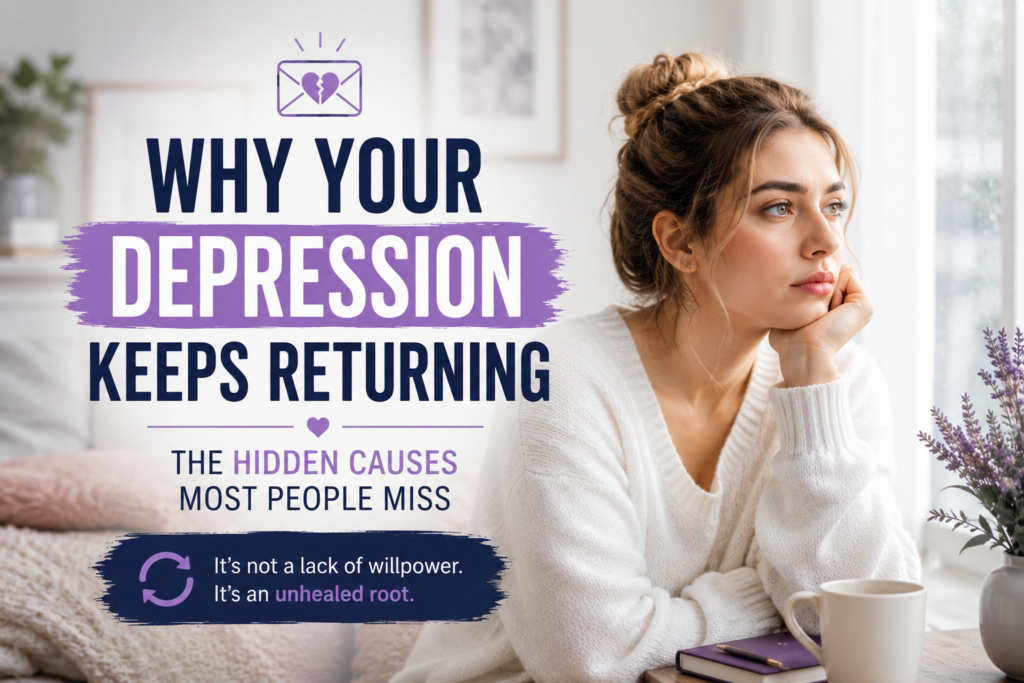
“I Thought I Was Better… So Why Am I Feeling Depressed Again?”
You’ve done the work.
You read the books.
You listened to the podcasts.
You attended therapy.
You started exercising.
You tried positive thinking.
For a while, things improved.
You felt lighter.
More motivated.
More hopeful.
Then suddenly, weeks or months later, the familiar feelings returned.
The exhaustion.
The emptiness.
The lack of motivation.
The emotional heaviness.
And you found yourself asking:
“Why does my depression keep coming back?”
Many people assume recurring depression means they have failed.
That they didn’t work hard enough.
That they aren’t healing correctly.
But in many cases, recurring depression isn’t a sign of failure.
It’s a sign that the underlying cause has not yet been fully understood.
The Mistake Most People Make
When depression becomes overwhelming, most people focus on making the symptoms disappear.
They want to:
These are understandable goals.
But focusing only on symptoms can sometimes create a cycle of temporary relief rather than lasting healing.
Imagine pulling weeds from a garden.
You remove what is visible above the soil.
The garden looks clean.
A few weeks later, the weeds return.
Not because you did something wrong.
Because the roots remained underground.
Depression often works the same way.
The symptoms may improve.
But if the deeper emotional roots remain untouched, the cycle can repeat.
Depression Is Often a Signal, Not the Root Problem
Many people think depression is the disease.
In reality, depression is often the nervous system’s response to something deeper.
Something unresolved.
Something unmet.
Something unhealed.
The depression is visible.
The true cause often remains hidden beneath the surface.
This is why symptom management alone sometimes fails to create lasting change.
Hidden Cause #1: The Life You’re Living Doesn’t Match Who You Really Are
One of the most overlooked causes of recurring depression is living a life that is disconnected from your authentic self.
You may be:
From the outside, everything may appear fine.
Internally, however, there is a growing disconnect.
Over time, that disconnect creates emotional exhaustion.
The depression isn’t necessarily the problem.
It may be the consequence of abandoning yourself for too long.
Hidden Cause #2: Unresolved Childhood Wounds
Many adults believe depression begins in adulthood.
But often the foundations were laid much earlier.
Children who grow up experiencing:
Often develop subconscious beliefs such as:
These beliefs become invisible operating systems.
They influence relationships.
Career choices.
Self-worth.
Decision-making.
Even when life improves, the old wounds remain active.
As a result, depression can continue resurfacing because the original emotional injury never healed.
Hidden Cause #3: Functional Depression
Some people don’t appear depressed at all.
They go to work.
Pay bills.
Raise children.
Attend meetings.
Smile socially.
Accomplish goals.
Yet internally, they feel disconnected, numb, exhausted, and empty.
This is sometimes referred to as high-functioning or functional depression.
Because they continue performing, nobody notices their suffering.
Including themselves.
Years of emotional suppression eventually catch up.
What looks like sudden depression is often the result of years of emotional depletion.
Hidden Cause #4: Chronic Self-Criticism
Many people speak to themselves in ways they would never speak to someone they love.
Their internal dialogue sounds like:
Living with a harsh inner critic creates constant emotional pressure.
Eventually the mind becomes exhausted.
The result can look very similar to depression.
The issue isn’t laziness.
The issue is emotional burnout caused by relentless self-judgment.
Hidden Cause #5: Unprocessed Grief
Not all grief comes from losing a loved one.
People also grieve:
Many people never allow themselves to fully feel these losses.
They stay busy.
Stay productive.
Stay distracted.
Yet grief doesn’t disappear because it is ignored.
It often remains stored within the emotional system.
Years later, that unresolved grief may contribute to recurring depressive symptoms.
Hidden Cause #6: Living in Survival Mode
Many people with depression have spent years in survival mode.
Constantly solving problems.
Constantly caring for others.
Constantly managing stress.
Constantly pushing through exhaustion.
At some point, the nervous system can no longer sustain that level of activation.
The result is often emotional shutdown.
Loss of motivation.
Fatigue.
Numbness.
Hopelessness.
What people call depression may sometimes be a nervous system that has been overwhelmed for too long.
Why Awareness Alone Doesn’t Always Create Change
Many people eventually recognize the source of their depression.
They understand where their patterns come from.
They know why they struggle.
Yet they still feel stuck.
This can be frustrating.
But healing requires more than intellectual understanding.
You can understand your wound and still carry its emotional impact.
Real transformation often requires working with both conscious awareness and subconscious programming.
The Subconscious Roots of Depression
Many depressive patterns are reinforced by subconscious beliefs formed years earlier.
Examples include:
These beliefs often operate automatically.
Most people aren’t even aware they exist.
Yet they continue influencing emotions, behaviors, relationships, and life experiences.
Until these deeper patterns are addressed, depression may continue returning despite external improvements.
Root Cause Healing vs Symptom Relief
Symptom relief focuses on:
Root cause healing focuses on:
Both approaches have value.
But only one addresses the source.
How My Programs Help Address Recurring Depression
In my counselling, hypnotherapy, subconscious reprogramming, and inner child healing programs, we don’t simply focus on helping clients manage depression.
We explore the deeper factors contributing to it.
Together, we identify:
The goal is not simply to feel better temporarily.
The goal is to create lasting change by healing the roots beneath the symptoms.
Because when the root transforms, the symptom often loses its purpose.
Final Thoughts
If your depression keeps returning, it doesn’t mean you’re broken.
It doesn’t mean healing isn’t possible.
And it certainly doesn’t mean you’ve failed.
It may simply mean that depression is trying to draw your attention toward something deeper.
Something that has not yet been fully seen.
Fully understood.
Or fully healed.
Instead of asking:
“Why can’t I get rid of my depression?”
Try asking:
“What is my depression trying to show me?”
That single question can become the beginning of a very different healing journey.
One that moves beyond symptom management and toward lasting transformation.

What If Depression Isn’t Trying to Hurt You? Most people see depression as…

What If Depression Is Not Your Enemy? Most people spend years fighting depression.…

Most People Are Looking in the Wrong Direction When people experience depression, they…
Discover your emotional baseline. Where should we send your personalized results?
Question 1 of 35
Question 2 of 35
Question 3 of 35
Question 4 of 35
Question 5 of 35
Question 6 of 35
Question 7 of 35
Question 8 of 35
Question 9 of 35
Question 10 of 35
Question 11 of 35
Question 12 of 35
Question 13 of 35
Question 14 of 35
Question 15 of 35
Question 16 of 35
Question 17 of 35
Question 18 of 35
Question 19 of 35
Question 20 of 35
Question 21 of 35
Question 22 of 35
Question 23 of 35
Question 24 of 35
Question 25 of 35
Question 26 of 35
Question 27 of 35
Question 28 of 35
Question 29 of 35
Question 30 of 35
Question 31 of 35
Question 32 of 35
Question 33 of 35
Question 34 of 35
Question 35 of 35
Discover your emotional baseline. Where should we send your personalized results?
Question 1 of 28
Question 2 of 28
Question 3 of 28
Question 4 of 28
Question 5 of 28
Question 6 of 28
Question 7 of 28
Question 8 of 28
Question 9 of 28
Question 10 of 28
Question 11 of 28
Question 12 of 28
Question 13 of 28
Question 14 of 28
Question 15 of 28
Question 16 of 28
Question 17 of 28
Question 18 of 28
Question 19 of 28
Question 20 of 28
Question 21 of 28
Question 22 of 28
Question 23 of 28
Question 24 of 28
Question 25 of 28
Question 26 of 28
Question 27 of 28
Question 28 of 28
Discover your emotional baseline. Where should we send your personalized results?
Question 1 of 35
Question 2 of 35
Question 3 of 35
Question 4 of 35
Question 5 of 35
Question 6 of 35
Question 7 of 35
Question 8 of 35
Question 9 of 35
Question 10 of 35
Question 11 of 35
Question 12 of 35
Question 13 of 35
Question 14 of 35
Question 15 of 35
Question 16 of 35
Question 17 of 35
Question 18 of 35
Question 19 of 35
Question 20 of 35
Question 21 of 35
Question 22 of 35
Question 23 of 35
Question 24 of 35
Question 25 of 35
Question 26 of 35
Question 27 of 35
Question 28 of 35
Question 29 of 35
Question 30 of 35
Question 31 of 35
Question 32 of 35
Question 33 of 35
Question 34 of 35
Question 35 of 35
Discover your emotional baseline. Where should we send your personalized results?
Question 1 of 21
Question 2 of 21
Question 3 of 21
Question 4 of 21
Question 5 of 21
Question 6 of 21
Question 7 of 21
Question 8 of 21
Question 9 of 21
Question 10 of 21
Question 11 of 21
Question 12 of 21
Question 13 of 21
Question 14 of 21
Question 15 of 21
Question 16 of 21
Question 17 of 21
Question 18 of 21
Question 19 of 21
Question 20 of 21
Question 21 of 21
Discover your emotional baseline. Where should we send your personalized results?
Question 1 of 21
Question 2 of 21
Question 3 of 21
Question 4 of 21
Question 5 of 21
Question 6 of 21
Question 7 of 21
Question 8 of 21
Question 9 of 21
Question 10 of 21
Question 11 of 21
Question 12 of 21
Question 13 of 21
Question 14 of 21
Question 15 of 21
Question 16 of 21
Question 17 of 21
Question 18 of 21
Question 19 of 21
Question 20 of 21
Question 21 of 21